
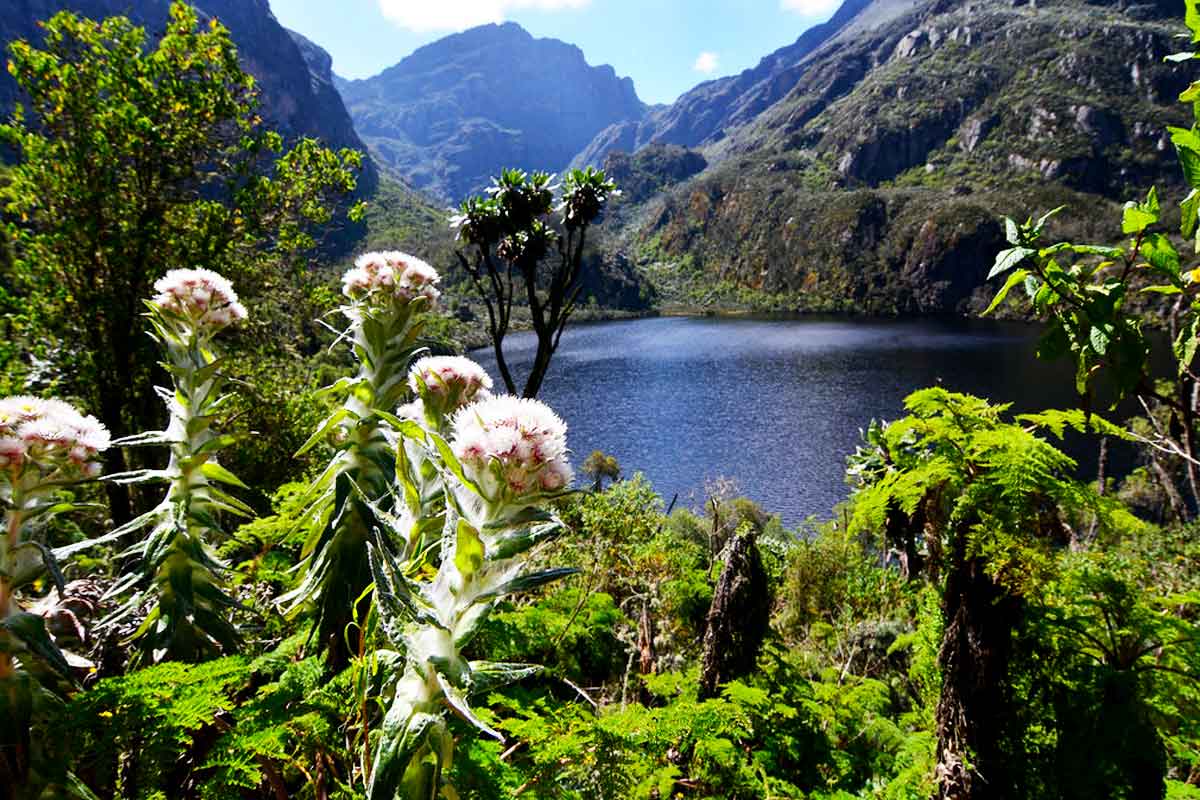
Margherita Peak is Africa’s third highest peak, but the real beauty is in the climb: forests and valleys of ferns, with diverse flora. The trees are alive with birds and primates, and as you walk up the trail you will see chimpanzee nests high in the tall trees. If you are lucky you may catch a glimpse of the resident chimpanzees as they scamper away. Climbing Margherita Peak is more of a hard scramble than a climb, apart from a few difficult moves, and it is harder when it snows. The reward of reaching the top is enormous, as you look across Albert Peak to DR Congo and east across the Rwenzori Mountains.
We provide all the technical equipment for the climb, such as ropes, harnesses and carabiners. You need to bring good hiking boots, warm clothing, a warm sleeping bag and rain gear. Sleeping bags can be hired if you need one.
The climb to Margherita Peak is now technical. Knowledge of ropes, crampons, ascenders and figure 8s for belaying, and of how to use an ice axe, is advisable. Ice sections are steep and change quickly as the glacier melts. All our guides are trained in ice climbing and rescue and can guide you up with little experience, but you must be prepared to learn on the way, fit your own crampons, tie basic knots and use ascenders and figure 8s. Mount Baker and Mount Speke are also technical. We advise bringing your own crampons, as the mix of hard ice and rock wears them out; crampons can be rented for an extra USD 20 per trip.
| Group size | Price per person |
|---|---|
| 1 person | USD 3,200 |
| 2 people | USD 2,400 |
Our representative will welcome you at Entebbe International Airport and transfer you to your hotel for the night at Lake Victoria View Guesthouse.
After breakfast, transfer to Rwenzori Mountains National Park, also known as the Mountains of the Moon. The drive takes about 7 hours, with lunch in Fort Portal before continuing to Mihunga. The equatorial snow peaks include the third highest point in Africa: Margherita (5,109m), Alexandra (5,083m) and Albert (5,087m). Overnight at Ruboni Rest Camp.
Start at the Rwenzori Mountaineering Services offices at Nyakalengija (1,615m). Arrive in the morning to allow ample time to rent equipment and meet your guides and porters. The trail begins by passing through farmland to the park boundary, then follows a thick forest along the Mubuku River, crossing its Mahoma River tributary before a long, steep climb up onto a massive ridge to reach Nyabitaba hut. Along the way you may hear chimpanzees and see black and white colobus, blue monkeys and the brilliantly coloured Rwenzori turaco.
The hike takes an average of 6 to 7 hours.
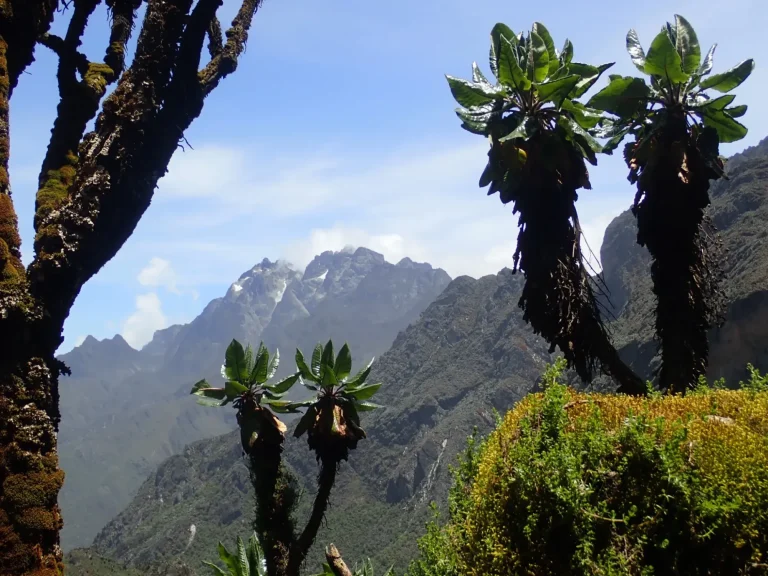
From Nyabitaba the trail drops through the forest to the Kurt Shafer Bridge, just below the confluence of the Mubuku and Bujuku rivers. Passing through bamboo forest, you cross a long and exhausting stretch of slippery moss-covered rock. From the Nyamuleju rock shelter, Mount Stanley and Mount Speke come into view before you enter the zone of giant heather, lobelia and groundsel. After crossing a tiring bog you reach John Matte Hut for dinner and overnight.
The hike takes an average of 7 to 8 hours.
From John Matte Hut the trail drops to cross the Bujuku River and enters Lower Bigo Bog, home of the giant lobelias. Jumping from tussock to tussock, the bog is finally crossed, though rarely without your feet sampling some of the freezing ooze below. Upper Bigo Bog gives way to Bujuku Lake, with views of Mount Baker to the south and Mount Stanley to the west. Bujuku Hut sits in the shadow of Mount Baker and Mount Speke, in a narrow valley below Stuhlmann Pass. The camp is good for acclimatisation before attempting the summits of Mount Stanley and Mount Speke. Dinner and overnight at Bujuku hut.
The hike takes an average of 4 to 5 hours.
Early in the morning, hike through Stuhlmann Pass (4,192m), with spectacular views of Virunga National Park in DR Congo, to Vittorio Emanuele Peak on Mount Speke. The ascent takes 4 to 5 hours.
Descend back to Bujuku Camp from Vittorio Emanuele, with views of the Bujuku valley and lake, Margherita and Albert peaks on Mount Stanley, and Mount Baker. Overnight at Bujuku Camp.
The descent takes an average of 3 to 4 hours.
Leaving Bujuku, the trail takes you through more bog, then climbs the steep slopes west of the lake and through the magical forest of Groundsel Gully. Turn right up to Elena Hut and Mount Stanley on a steep trail over large boulders; the trail to the left leads to Scott-Elliot Pass and down to the Kitandara Lakes, and is taken by those not climbing Margherita Peak to Kitandara Hut. Those climbing the peak have dinner and overnight at the cold and icy Elena Hut.
The hike takes an average of 5 to 6 hours.
Very early in the morning, you attempt the highest peak, Margherita on Mount Stanley. The climb to the summit takes about 4 to 5 hours, depending on the weather and your pace. This tough route takes you over three glaciers, slippery rock, ice and very exposed areas. Climbing onto the glaciers, you cross the Stanley Plateau and continue the ascent through fog, altitude and cold, scrambling up to the summit of Margherita, the highest peak of the Rwenzori. The descent back to Elena Hut takes about 2 to 3 hours.
After lunch at Elena Hut, descend to Scott-Elliot Pass (4,372m), with spectacular views of Bujuku Lake and Mount Speke. The trail then passes through an alpine zone of sparse vegetation and rough boulders, descending past the Kitandara Lakes for dinner and overnight at Kitandara Camp.
The descent takes an average of 3 to 4 hours.
The climb starts early in the morning from Kitandara Camp through Freshfield Pass (4,215m), with views of DR Congo, up to Edward Peak on Mount Baker. The ascent takes about 5 to 6 hours.
From Edward Peak, descend back to Freshfield Pass and on to Kitandara Camp for the night.
The descent takes an average of 3 to 4 hours.
From Kitandara, the trail climbs steeply up the headwall spreading out from the base of Mount Baker and continues along the south side of the mountain to Freshfield Pass (4,282m). From here you can look into Congo to the west and Mount Stanley to the north.
From the pass, the trail crosses a long, high alpine moss zone, then descends steep rocky trails past the rock shelter at Bujongolo, the base camp of the Duke of the Abruzzi's historic 1906 expedition, to Guy Yeoman camp for the night.
The hike takes an average of 6 to 7 hours.
Below Guy Yeoman, the route descends the cliffs of Kichuchu. Beyond Kichuchu, the muddy path crosses the Mubuku River twice through bamboo forest before dropping to Nyabitaba to complete the circuit.
Continue down from Nyabitaba Camp and complete your trek by evening at Nyakalengija (1,615m), the base camp. Overnight at Ruboni Rest Camp.
The descent takes 7 to 8 hours.
Drive back to Entebbe. Alternatively, add 2 days to see chimpanzees, gorillas or the wildlife of Queen Elizabeth National Park and see more of what Uganda has to offer.
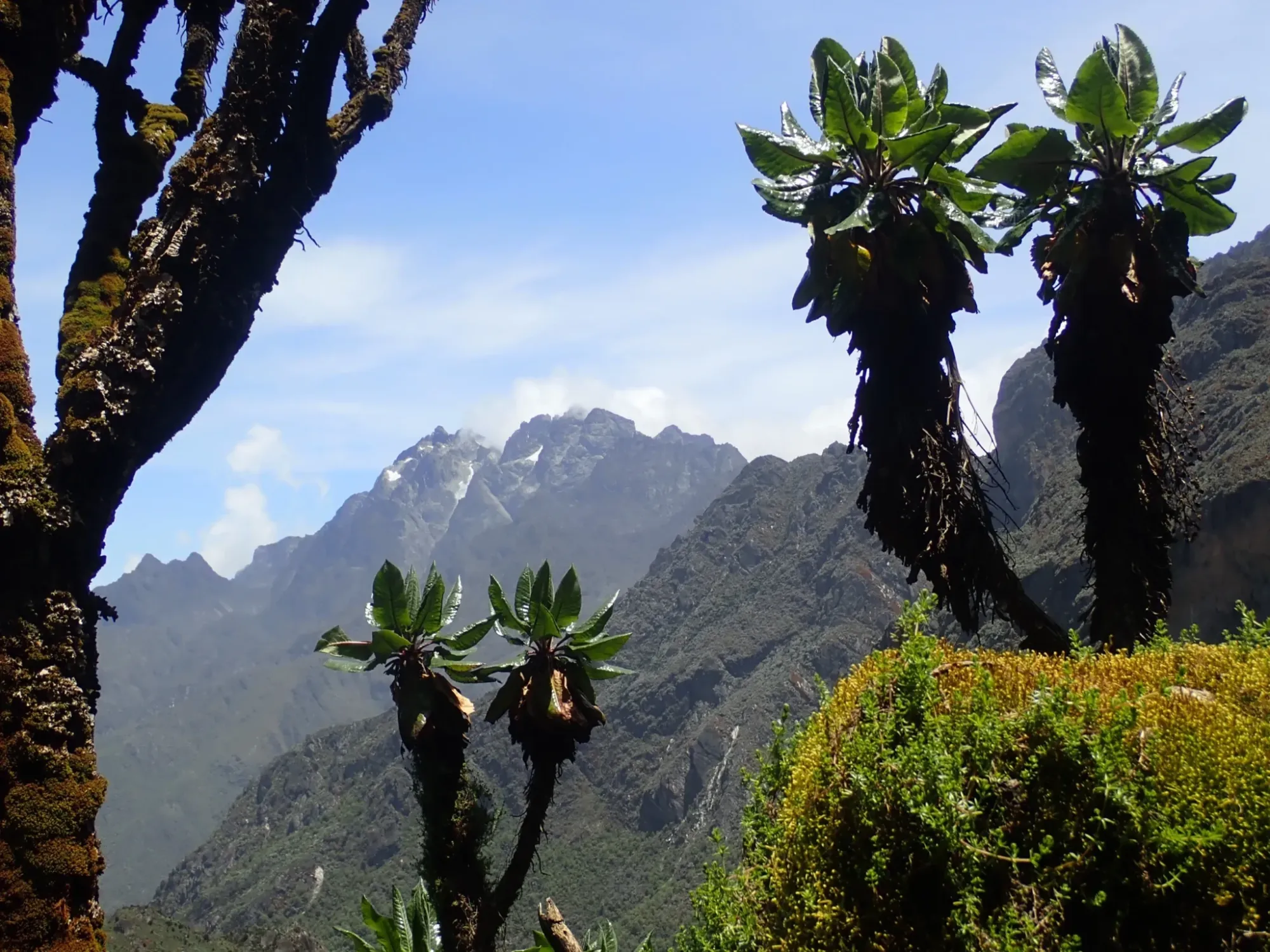
Rwenzori Mountains National Park, Uganda
3 Day

11 Day
Write Your Review